NEWS
AFRILAW Workshop: Human Rights Defenders Seek Constitutional Reform to Make Socio-Economic Rights Enforceable
AFRILAW Wants Citizens Empowered to Sue Government Over Basic Services
Section II of the Constitution Justiciable
Stronger Protection of Human Rights Defenders

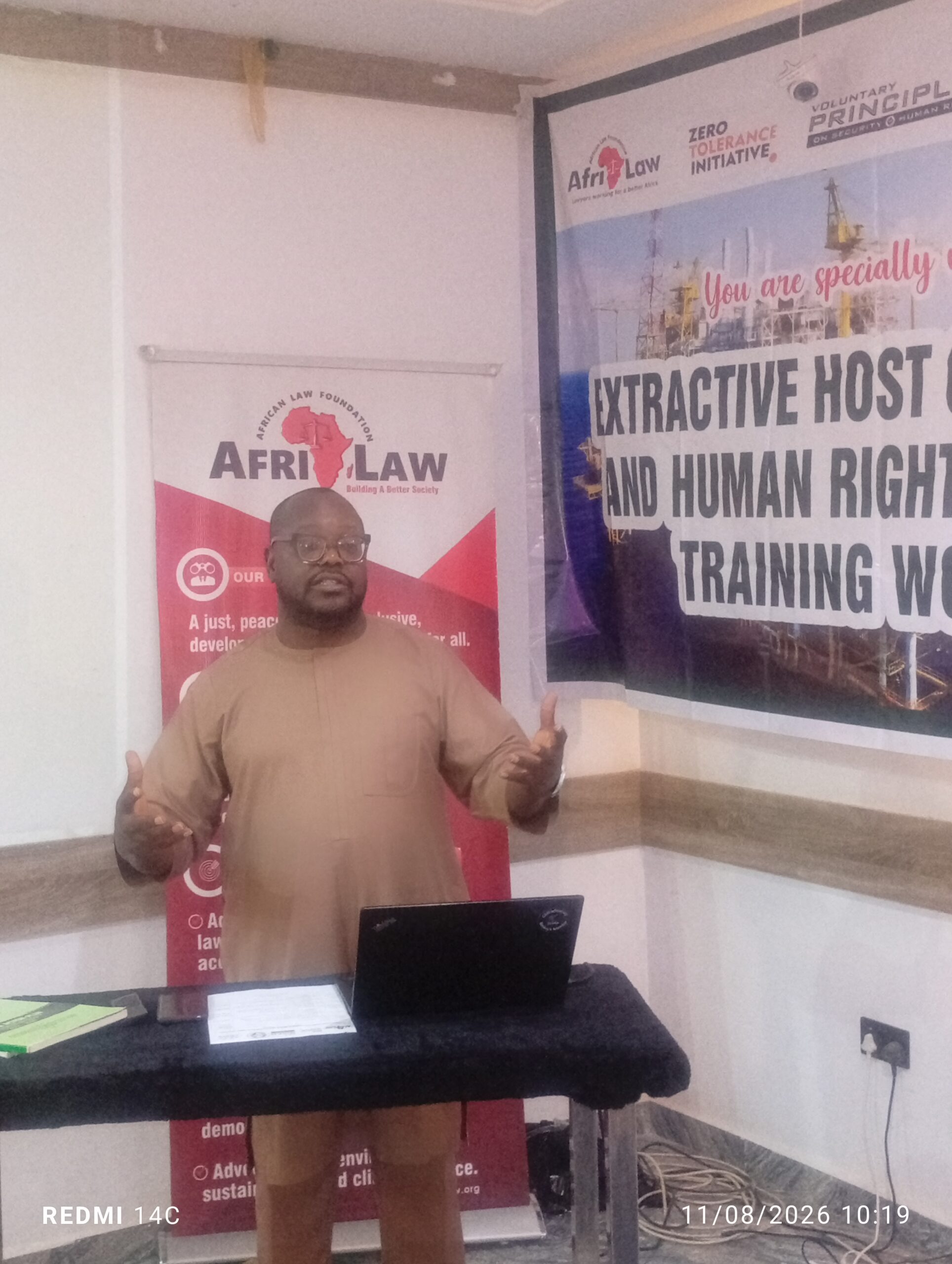
UMUAHIA — Participants at a one-day training workshop on extractive host communities and human rights defenders have called for constitutional reforms to make socio-economic rights enforceable, insisting that citizens must be able to hold government accountable for failures in the provision of basic services.
The workshop, held on Tuesday, August 11, 2026, in Umuahia, Abia State, was organised by the African Law Foundation (AFRILAW), Abuja, in partnership with the National Human Rights Commission (NHRC), Nigeria Working Group on the Voluntary Principles (NWGPs) and the Voluntary Principles Initiative (VPI).
The programme received funding support from the Zero Tolerance Initiative (ZTI) and True Cost Initiative (TCI), USA.
The training brought together environmental human rights defenders from extractive host communities, journalists and civil society organisations across the Niger Delta region, with the objective of strengthening their capacity to promote and protect human rights in Nigeria’s extractive sector.
The organisers said the workshop was also designed to equip participants with knowledge of the VPI and United Nations Guiding Principles on Business and Human Rights (UNGPs) guidance tools for respecting and protecting human rights defenders.
The training was chaired by the Executive Secretary of the National Human Rights Commission.
Speaking at the workshop, the Founder and Chief Executive Officer of AFRILAW, Okereke Chinwike, Esq., said Nigeria’s constitutional framework currently creates a major obstacle to citizens seeking redress over failures by government to provide essential social and economic services.
Chinwike said while provisions relating to socio-economic rights such as healthcare and education are contained in Chapter II of the 1999 Constitution, they are generally non-justiciable under the current constitutional arrangement.
According to him, non-justiciability means that citizens cannot ordinarily approach the courts to compel government to fulfil those constitutional directives.
He argued that the situation weakens accountability and undermines good governance, stressing that human rights must be enforceable where violations occur.
“Until we remove that non-justiciability of that section, good governance will keep eroding us,” he said.
The AFRILAW chief executive maintained that government should be held accountable when it fails to provide basic services for which public funds are appropriated.
AUDIO 1
He called for a constitutional amendment that would give the socio-economic provisions in Chapter II enforceability similar to other constitutional provisions that can be judicially enforced.
Chinwike also linked the issue to corruption and the management of public funds, arguing that citizens should have stronger legal mechanisms to question government when resources budgeted for healthcare, education and other social services are not properly utilised.
He said the absence of effective judicial enforcement makes it difficult for ordinary citizens to demand accountability for failures in the delivery of basic services.
He therefore urged stakeholders, including human rights defenders, civil society organisations and the media, to intensify advocacy for constitutional reform.
AUDIO 2
Chinwike said making the socio-economic rights provisions enforceable would strengthen democratic accountability and ensure that the dividends of democracy translate into tangible improvements in the lives of Nigerians, adding that citizens should not be left without legal remedies when their fundamental social and economic needs are not adequately provided.
The workshop also provided a platform for participants from extractive host communities, Media as well professionals from different walks of life to deepen their understanding of human rights protection, corporate responsibility and the role of human rights defenders in addressing abuses associated with extractive activities.


APGA Flags Off 2027 Campaign in Abia, as Chairman Tasks Candidates on Victory, Promises Massive Support

Governor Otti Approves Training Of 1000 Youths In THRIVEABIA Digital Capacity Programme

CityBoy Movement Abia Director, Igbokwe, Hails Seyi Tinubu on Birthday

Governor Otti Inaugurates Board Of Abia State Electricity Regulatory Authority , Vows To Pull Umuahia Out Of National Grid

Tacha most nominated housemate in history of BBNaija ― Cross
