Politics
Onuigbo: Wike, Soludo, Adeleke Deserve Places in Tinubu’s Campaign Council
Says Tinubu Has Put Nigeria on Path to Prosperity, Cites Economic Gains

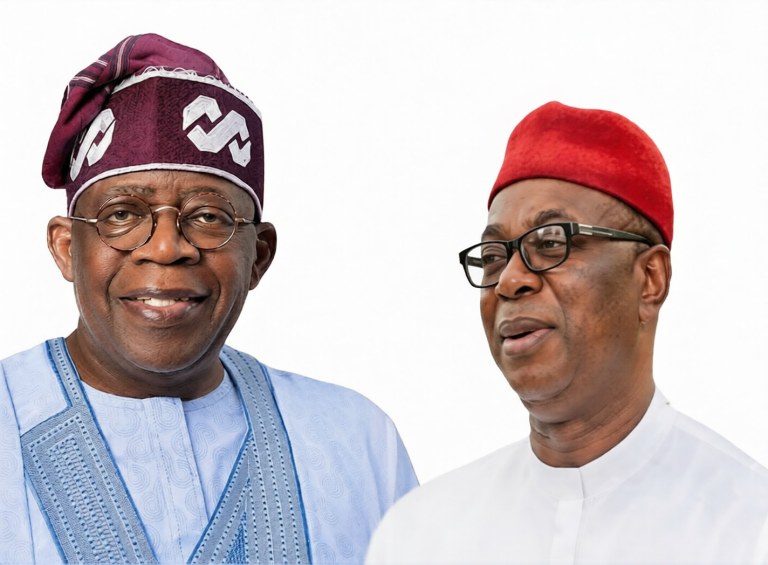
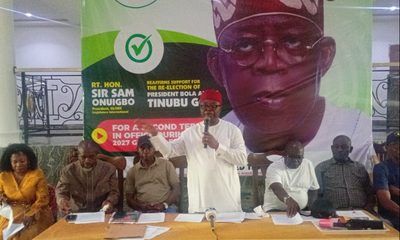
The inclusion of prominent opposition politicians in President Bola Tinubu’s re-election campaign has been defended as a demonstration that democratic alliances can transcend party affiliations, with former federal lawmaker Rt. Hon. Sir Sam Ifeanyi Onuigbo describing the move as democracy in action.
Onuigbo, a chieftain of the All Progressives Congress (APC), said Minister of the Federal Capital Territory (FCT), Nyesom Wike; Anambra State Governor, Chukwuma Soludo; and Osun State Governor, Ademola Adeleke, deserved their places in the President’s Presidential Campaign Council because of their support for his administration.
He made the remarks while speaking with journalists on Thursday in Abuja, arguing that political cooperation across party lines was justified when leaders shared a commitment to good governance and the welfare of Nigerians.
Wike belongs to the Peoples Democratic Party (PDP), Soludo is a member of the All Progressives Grand Alliance (APGA), while Adeleke is associated with the Accord Party.
Onuigbo, who represented Ikwuano/Umuahia North and South Federal Constituency in the Eighth and Ninth National Assemblies, described the appointments as the product of a democratic alliance founded on confidence in Tinubu’s administration.
He maintained that democracy was not about the use of force or rigid adherence to party boundaries, but about consensus, mutual understanding and the pursuit of governance that benefits the greatest number of citizens.
According to him, the decision by politicians from opposition parties to join Tinubu’s campaign reflected their belief that his administration had delivered results worth supporting. He consequently described their inclusion in the APC’s presidential campaign structure as commendable and a practical demonstration of democratic cooperation.
Beyond the political realignment, Onuigbo gave Tinubu’s economic policies and reforms a positive assessment, citing the Nigerian Education Loan Fund (NELFUND), exchange-rate harmonisation and removal of the fuel subsidy among the administration’s major interventions.
He said subsidy removal had made additional resources available to the Federal Government and sub-national governments for investment in infrastructure and other projects intended to improve citizens’ welfare.
Assessing the country’s economic performance, Onuigbo said Nigeria’s gross domestic product (GDP) growth had outpaced population growth and pointed to improvements in the country’s oil sector and foreign reserves as evidence of economic progress.
“Tinubu has placed Nigeria on the path of prosperity, with GDP growth now outpacing the nation’s population growth. From refining 30,000 barrels of oil per day in 2023, Nigeria now refines over 700,000 barrels of crude oil per day. Nigeria’s foreign reserves have now risen to over $58.1 billion, from $3.9 billion in 2023,” he told journalists.
Recent oil production figures provide further context to the administration’s economic performance. Data from the Nigerian Upstream Petroleum Regulatory Commission (NUPRC) showed that Nigeria’s average daily crude oil production, excluding condensates, rose to 1.53 million barrels in September 2026, exceeding its Organisation of the Petroleum Exporting Countries (OPEC) quota of 1.5 million barrels per day.
Combined crude oil and condensate production averaged approximately 1.717 million barrels daily during the month, with output peaking at 1.84 million barrels on the highest-producing day. The September performance marked the fifth consecutive month in which Nigeria met its crude oil production quota.
The country has, however, continued to face the challenge of sustaining production gains, making improved output and reliable oil-sector operations important indicators to watch as the government pursues higher revenue and economic growth.
On the cost of living, the latest inflation figures also showed a moderation in price increases. The National Bureau of Statistics reported that headline inflation eased to 14.63 per cent in September 2026, down from 15.39 per cent in August.
Foreign investment figures present a mixed picture. Nigeria recorded $923.01 million in foreign direct investment (FDI) in 2025, up from $674.71 million in 2024, representing an increase of about 36.8 per cent. However, FDI accounted for only 3.97 per cent of total capital importation during 2025, indicating that the broader rise in foreign capital inflows was driven largely by portfolio investment rather than long-term direct investment.
The increase in FDI nevertheless provides an additional indicator of foreign investment activity, although sustained growth in productive investment remains important for job creation, industrial expansion and economic development.
Onuigbo also highlighted the establishment of the Nigerian Consumer Credit Corporation, which he said was designed to broaden access to consumer credit for Nigeria’s working population.
He added that the administration’s economic reforms had received recognition from international financial institutions, including the International Monetary Fund and the World Bank.
Reaffirming his confidence in Tinubu’s re-election prospects, the former lawmaker said the President had the capacity to strengthen Nigeria’s standing in the international community if returned to office.
He also commended Tinubu and Wike for infrastructure development in Abuja, arguing that projects undertaken by the APC-led Federal Government had helped address longstanding infrastructure deficits in the nation’s capital.









Onuigbo: Wike, Soludo, Adeleke Deserve Places in Tinubu’s Campaign Council

Otti Urges PRESCO To Begin Agro-Industrial Investment At ULONNA Farm Settlement

Mayor Lucky Igbokwe Celebrates Former Abia Governor Ambassador Ikpeazu On His Birthday

Governor Otti Inaugurates Board Of Abia State Electricity Regulatory Authority , Vows To Pull Umuahia Out Of National Grid

Tacha most nominated housemate in history of BBNaija ― Cross
