NEWS
Onuigbo Demands Immediate Implementation of LG Autonomy, Says Grassroots Governance Key to Nigeria’s Survival

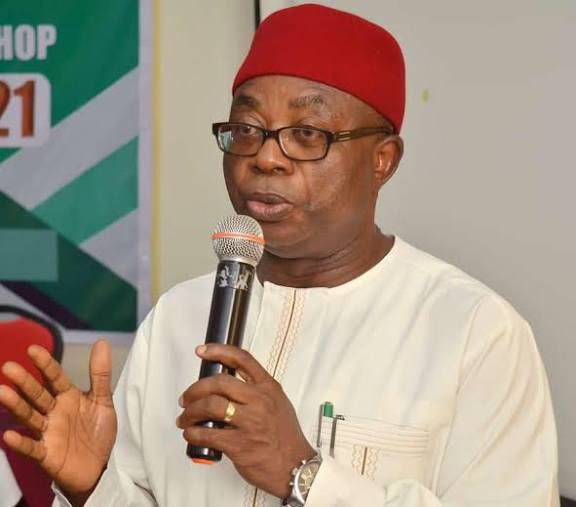
A renewed call for full financial and political autonomy for local governments in Nigeria took centre stage at the South East Summit on Reviving Local Governance, held in Umuahia, Abia State.
Delivering a goodwill message at the summit, Rep. Sir Sam Onuigbo, member representing the South East on the Governing Board of the North East Development Commission, emphasized that strengthening local governance remains critical to Nigeria’s democratic and developmental future.
The event, which took place at the Bishop Nwaedo Pastoral Centre, brought together stakeholders to deliberate on restoring effectiveness to Nigeria’s third tier of government.
Rep. Onuigbo noted that local governments were constitutionally established to bring governance closer to the people and accelerate grassroots development, stressing that any erosion of their autonomy weakens the nation’s federal structure.
He explained that the Nigerian Constitution clearly recognizes democratically elected local government councils as an essential tier of governance, with defined responsibilities including primary healthcare support, local infrastructure development, markets management, and rural development initiatives.
However, he lamented that since Nigeria’s return to democracy in 1999, the autonomy of local councils has steadily declined, largely due to excessive state control of funds through the State–Local Government Joint Account system.
According to him, this has resulted in weakened service delivery, deteriorating infrastructure in rural areas, and reduced public confidence in grassroots administration.
Rep. Onuigbo highlighted the crucial role of local governments in employment generation, infrastructure development, and grassroots security support, noting that empowered councils can stimulate rural economies through public works, agricultural support services, and community-based initiatives.
He described the 2024 Supreme Court judgement in the case between the Attorney-General of the Federation and the 36 state governments as a major turning point.
The ruling affirmed that allocations meant for local governments from the Federation Account must be paid directly to them, reinforcing their financial independence and limiting unconstitutional interference.
The former federal Lawmaker commended President Bola Ahmed Tinubu for supporting the legal steps that led to the judgement, describing it as a bold move toward restoring fiscal federalism at the grassroots.
He, however, stressed that implementation remains key, warning that delays or attempts to circumvent the ruling could undermine constitutional order.
Onuigbo also raised concerns about the performance of State Independent Electoral Commissions, saying their failure to conduct credible and transparent local government elections has weakened grassroots democracy.
He called on the National Assembly to amend relevant constitutional provisions to strengthen the independence and effectiveness of these commissions.
Onuigbo further called for the repeal or outright abolition of Sections 124 and 197 of the 1999 Constitution, arguing that State Independent Electoral Commissions should not be responsible for conducting local government elections.
He maintained that since local government funds are drawn from the Federation Account, it is inappropriate for state-controlled bodies to preside over their elections. Onuigbo noted that historical records have shown that SIECs often fail to conduct credible polls, instead producing outcomes that reflect candidates allegedly pre-selected by state governors.
The Chairman of the Committee on Security, Climate Change, and Special Interventions on the NEDC, therefore advocated for a constitutional amendment to transfer the responsibility for local government elections to a national electoral body, insisting that such a move would enhance transparency, credibility, and true grassroots democracy.
Rep. Onuigbo concluded by urging immediate and comprehensive enforcement of local government financial autonomy, insisting that Nigeria’s developmental challenges — including rural poverty, unemployment, and insecurity — cannot be effectively addressed without revitalized grassroots governance.
He maintained that restoring local government autonomy is not optional but a constitutional obligation necessary for inclusive growth and democratic consolidation.
Recall that in the years past, Onuigbo during interviews by different media platforms has always been vocal on the need for local governments in Nigeria to be allowed to breathe financially and administratively. During one of such interviews, he had this to say.
AUDIO 1
The former Lawmaker during the interview maintained that the federal government under President Tinubu had done its part, but noted that Governors were the clog in the wheel of progress.
AUDIO 2
At the time, he said the funds accrued so far to the LGAs in the country, unaccounted for and heavily mismanaged by the state Governors ran into hundreds of billions.
AUDIO 3
See full statement below:
A GOODWILL MESSAGE PAPER PRESENTED BY REP. SIR SAM I. ONUIGBO FCIS, FNIM, KJW, MEMBER (SOUTH EAST), ON THE GOVERNING BOARD AND CHAIRMAN, COMMITTEE ON SECURITY, CLIMATE CHANGE, AND SPECIAL INTERVENTIONS, NORTH EAST DEVELOPMENT COMMISSION, DURING SOUTH EAST SUMMIT ON REVIVING LOCAL GOVERNANCE HELD AT BISHOP NWAEDO PASTORAL CENTRE, BCA ROAD, UMUAHIA, ABIA STATE, ON THE 19TH FEBRUARY 2026.
Protocols
I am honoured to lend my voice to this timely and necessary conversation on the revival of local governance in Nigeria. The question before us is not abstract. It goes to the very architecture of our federal system, the integrity of our Constitution, and the lived realities of millions of Nigerians whose first and most immediate contact with government is at the local level.
Local government administration in Nigeria was conceived as the third tier of government , not ornamental, not subordinate, but constitutionally recognised and functionally indispensable. Its purpose is clear: to bring governance closer to the people, deepen participatory democracy, and accelerate grassroots development. Any distortion of that purpose weakens the entire federal structure.
CONSTITUTIONAL FOUNDATION OF LOCAL GOVERNMENT
The authority and legitimacy of local governments are firmly rooted in the Constitution of the Federal Republic of Nigeria.
Section 7(1) provides unequivocally for “the system of local government by democratically elected local government councils.” This is not permissive language; it is mandatory. It affirms that local governments are a constitutional creation, not a discretionary extension of state governments.
Section 162(3) mandates that revenue from the Federation Account be distributed among the Federal Government, the State Governments, and the Local Government Councils. Section 162(5) further provides that the amount standing to the credit of local government councils shall be allocated to the states for the benefit of their local governments. Section 162(6) establishes the State–Local Government Joint Account, while Section 162(8) requires that funds be distributed among local governments in accordance with a law enacted by the State House of Assembly.
In addition, the Fourth Schedule to the Constitution outlines the substantive functions of local governments. These include the construction and maintenance of local roads, streets and drains; the establishment and regulation of markets and motor parks; the provision and maintenance of public conveniences; participation in primary education and primary healthcare; registration of births, deaths and marriages; and agricultural and rural development initiatives.
The constitutional scheme is therefore unmistakable: local governments are meant to be development engines at the grassroots, equipped with defined responsibilities and backed by statutory funding.
With the return to democratic rule in 1999, there was widespread optimism that constitutional federalism would flourish. However, the period between 1999 and 2003 revealed a troubling pattern. Although elections were conducted at the local level, the practical autonomy of councils steadily eroded.
The State–Local Government Joint Account mechanism, though constitutionally recognised, became in practice a conduit for excessive state control. Allocations intended for local governments were frequently subjected to deductions, conditional approvals, and administrative constraints. Planning autonomy was curtailed. Financial discretion was diluted. In many instances, caretaker committees replaced democratically elected councils, contrary to the spirit of Section 7.
The cumulative effect was a gradual weakening of grassroots governance. Instead of serving as responsive institutions accountable to local electorates, many local governments became administratively dependent and politically constrained. The consequences have been visible in deteriorating rural infrastructure, weak service delivery, and declining citizen confidence in local administration.
IMPORTANCE OF LOCAL GOVERNMENTS IN STATE ADMINISTRATION
The significance of local governments within the broader political administration of a state cannot be overstated.
First, local governments are critical vehicles for employment generation. Through public works programmes, infrastructure projects, agricultural support services, sanitation initiatives and community-based enterprises, councils can stimulate local economies. Direct labour projects and small-scale contracting create opportunities for artisans, suppliers, transporters and small businesses. When local governments are empowered, rural unemployment declines.
Secondly, local governments are central to infrastructural development. They construct and maintain feeder roads that connect farms to markets. They build and maintain primary schools, markets, cottage hospitals and health centres. They regulate motor parks and commercial activities. These interventions, though localised, have multiplier effects on economic growth, educational attainment and public health outcomes.
Thirdly, security at the grassroots is intrinsically linked to effective local governance. While policing remains largely federal, local governments provide critical support structures. They facilitate community engagement, support local vigilance initiatives, address social welfare concerns that fuel insecurity, and coordinate traditional institutions and community leaders. Security is most sustainable when prevention begins at the local level.
Beyond these, local governments are responsible for environmental sanitation, waste management, birth and death registration, local economic planning, rural electrification support, and community mobilisation for public health campaigns. These are not peripheral matters; they are the daily realities that define governance in practical terms.
THE LANDMARK SUPREME COURT JUDGEMENT
A significant corrective milestone occurred in 2024 when the Supreme Court of Nigeria delivered a landmark judgement in Attorney-General of the Federation v. Attorney-General of the 36 States of the Federation (2024).
The Court held that funds standing to the credit of local governments in the Federation Account must be paid directly to them. It affirmed that state governments lack constitutional authority to withhold, divert or otherwise control these funds in a manner inconsistent with the Constitution. The judgement reinforced the constitutional guarantee of democratically elected local government councils and declared unconstitutional practices that undermine their tenure or financial independence.
This ruling was not merely interpretative; it was transformative. It reaffirmed constitutional supremacy and restored clarity to a long-contested issue. It placed beyond doubt that local governments are entitled to financial autonomy consistent with constitutional provisions.
FINANCIAL AUTONOMY: A DEMOCRATIC IMPERATIVE
Financial autonomy is not a theoretical aspiration; it is a practical necessity.
Without direct access to statutory allocations, local governments cannot prepare credible budgets or implement development plans with certainty. Fiscal unpredictability undermines procurement processes, weakens accountability, and distorts project prioritisation. When funds are controlled externally, accountability flows upward rather than downward.
Conversely, direct disbursement enhances transparency. It allows citizens to track allocations and evaluate performance. It strengthens internal audit mechanisms and promotes participatory budgeting. It encourages innovation tailored to local needs. Most importantly, it restores democratic accountability between elected councils and the electorate.
Financial autonomy also strengthens federalism. True federalism thrives when powers and resources are meaningfully decentralised. Concentrating fiscal authority at higher tiers breeds inefficiency and alienation. Distributing it in accordance with constitutional design promotes inclusivity and responsiveness.
EFFORTS OF THE CURRENT ADMINISTRATION
The administration of Bola Ahmed Tinubu GCFR has taken significant steps towards enforcing the constitutional status of local governments. By initiating and supporting the legal action that culminated in the Supreme Court judgement, the Federal Government demonstrated institutional commitment to restoring fiscal federalism at the grassroots.
Subsequent policy directives aimed at ensuring compliance with the Court’s decision represent a clear signal that constitutional governance must prevail. The emphasis on direct disbursement of allocations to local government councils reflects a recognition that sustainable development cannot occur where the third tier remains structurally constrained.
However, implementation remains the true test of commitment. Judicial pronouncements and executive directives must translate into uniform compliance across all states. Any attempt to circumvent or dilute the ruling would undermine constitutional order.
A FIRM CALL FOR IMMEDIATE IMPLEMENTATION
The issues before us are no longer subject to debate. The Constitution provides for democratically elected local governments. The Supreme Court has affirmed their financial autonomy. The Federal Government has expressed its resolve.
What remains is disciplined implementation.
Local governments must be allowed to function as constitutionally empowered institutions — fiscally independent, administratively competent, and democratically accountable. The continued delay or selective compliance in implementing financial autonomy is incompatible with the rule of law.
Nigeria’s developmental challenges, unemployment, rural poverty, infrastructural deficits, insecurity cannot be effectively addressed without revitalised local governance. Centralised solutions alone are insufficient. Development must be localised to be sustainable.
This summit must therefore rise above rhetoric. It must articulate a clear demand: immediate, unconditional and comprehensive enforcement of local government financial autonomy in Nigeria.
Nigeria’s Constitution recognises the importance of local government autonomy, yet this principle remains largely aspirational. Section 124 grants State Independent Electoral Commissions a first-line charge on the state’s Consolidated Revenue Fund, intending to shield them from gubernatorial influence and ensure that local government leadership reflects the will of the people. In practice, however, these commissions are chronically underutilised, their constitutional powers reduced to announcing election results that are too often pre-determined.
This underperformance is more than an administrative failing; it strikes at the heart of grassroots democracy. Local Governments, meant to be the people’s closest representation, are rendered ineffective when electoral bodies subordinate their duties to political expediency. Rather than safeguarding transparency, these commissions have become seasonal instruments, active only during elections and silent the rest of the time, leaving citizens with local councils that lack legitimacy and accountability.
The consequences are clear: local governments without autonomy, citizens without a voice, and a system in which constitutional safeguards are undermined by those entrusted with enforcing them. State Independent Electoral Commissions should not be passive actors. Their mandate must extend beyond result declaration to include continuous oversight, enforcement of electoral integrity, and protection of the people’s mandate from political interference.
It is time for the National Assembly to amend the constitution to address with clarity and purpose, the role of state Independent Electoral Commissions in Nigeria.
Through robust, empowered, and continuously engaged electoral commissions local governments can achieve genuine autonomy. Nigeria’s democracy will remain incomplete until these institutions fulfil their constitutional role, ensuring that local leadership is determined by the people, not by the governor.
The era of ceremonial commissions must end; the era of accountable, autonomous local government must begin.
I, therefore, commend President Tinubu GCFR for his dogged determination to achieve financial and political autonomy for local governments in Nigeria.
The restoration of local government autonomy is not a concession; it is a constitutional obligation. It is not a partisan issue; it is a structural necessity. It is not optional; it is imperative.
If we are serious about inclusive growth, accountable governance and democratic consolidation, we must return fully and faithfully to the constitutional vision of empowered local governments.
The time for incremental adjustments has passed. The Constitution has spoken. The Court has spoken. The nation must now act.
Thank you.










Abia Legislator Erondu Jnr Preaches Peace, Compassion at Easter

Easter Celebration: Onuigbo Seeks Unity, Peace, and Prosperity for Nigeria

500 Beneficiaries Smile Home as Osonwa Delivers Massive Empowerment Package

Governor Otti Inaugurates Board Of Abia State Electricity Regulatory Authority , Vows To Pull Umuahia Out Of National Grid

Tacha most nominated housemate in history of BBNaija ― Cross
